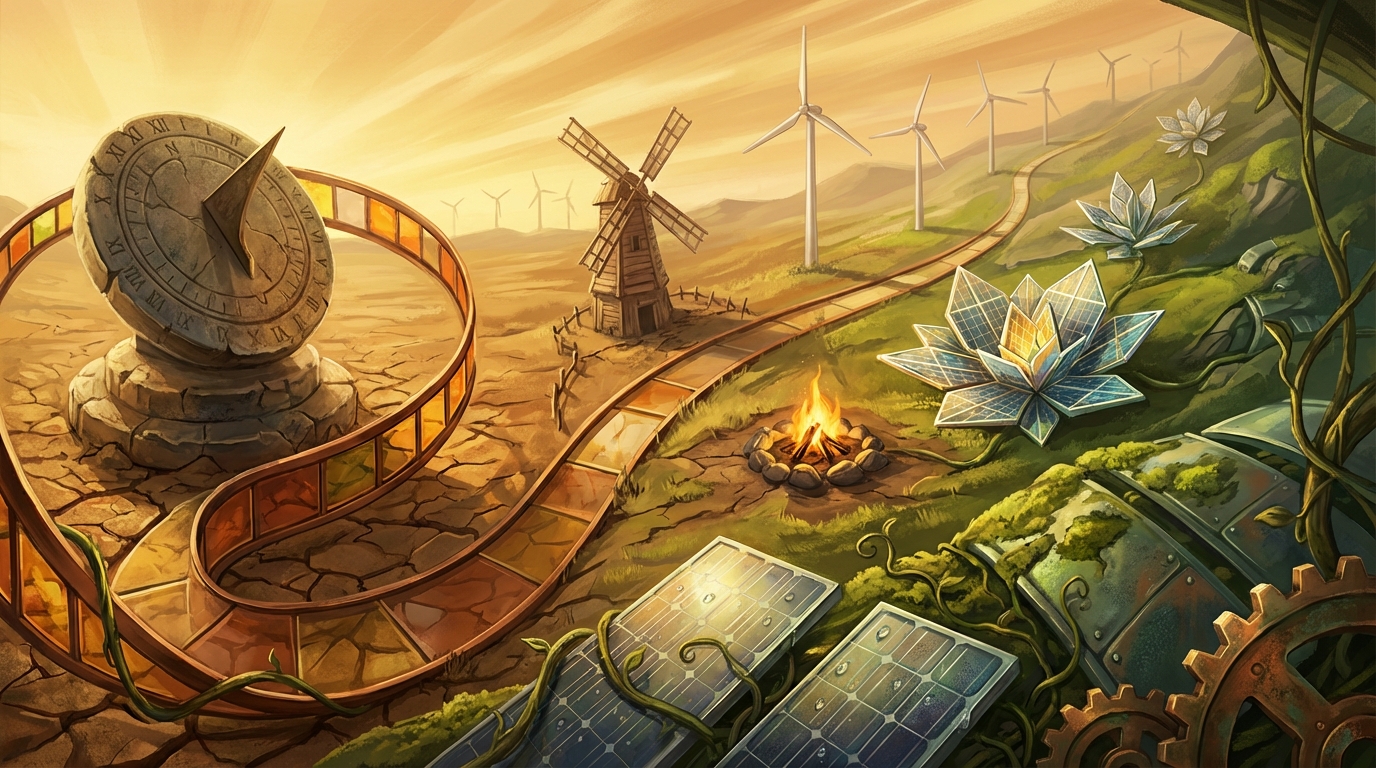
From Ancient Sunlight to Global Grids: The Story of Renewable Energy
Renewable energy didn't begin with silicon solar cells or sleek wind turbines. It began with fire, water, and wind - forces that humans harnessed thousands of years before anyone coined the term "clean energy." The path from ancient magnifying glasses lighting ceremonial flames to a global industry attracting $386 billion in the first half of 2025 alone is one of the most consequential stories in human civilization.
What makes this history remarkable isn't just the technology. It's the pattern: breakthrough, neglect, crisis, rediscovery. Again and again, renewable energy technologies proved themselves viable - only to be sidelined when fossil fuels were cheap and plentiful. Understanding this cycle matters because it reveals why the current renewable surge is fundamentally different from every previous wave, and why it's unlikely to reverse.
This article traces that full arc - from the Paleolithic era through the oil shocks of the 1970s, the policy experiments of the 1990s, and into the explosive growth that has reshaped global electricity in the 2020s.
Ancient Roots: Harnessing Nature Before Electricity
Solar power dates back to approximately 700 BCE, when ancient civilizations used primitive magnifying glasses to concentrate sunlight and start fires. By 300 BCE, Greeks and Romans had refined the concept with "burning mirrors" to light torches - a practice that spread to China by 20 BCE. These weren't power plants, but they established the foundational principle that sunlight could be captured and directed for practical use.
Wind energy has equally deep origins. As early as 5000 BCE, boats on the Nile used wind power for propulsion. By 200 BCE, windmills in China were pumping water, and by the 11th century, windmill-powered food production was common across the Middle East. The technology spread westward with extraordinary success - over 100,000 windmills eventually dotted the landscapes of England and Central Europe, and by 1590, the Dutch had adapted them for making paper and draining lakes to prevent flooding.
Geothermal energy use stretches back to the Paleolithic era, when humans bathed in hot springs. Hydropower followed with the Roman invention of the water wheel, which eliminated the need for human and animal labor in grinding grain and milling lumber. Coal mining began around 200 BCE, and windmills appeared as early as 644 AD - but for millennia, renewable sources were simply "energy," not an alternative to anything.
The Scientific Breakthroughs of the 19th Century
The modern renewable story begins with a French scientist named Edmond Becquerel, who discovered the photovoltaic effect in 1839 - the principle that sunlight striking certain materials could generate electric current. That same decade, in 1838, the first hydrogen fuel cell was invented, laying groundwork for clean fuel concepts that wouldn't mature for over a century.
Practical applications followed in rapid succession. In 1880, Thomas Edison patented the electric lamp, catalyzing the entire electrification movement. In 1882, the world's first hydroelectric power plant to sell electricity to the public opened on the Fox River near Appleton, Wisconsin. By 1887, Scottish electrical engineer James Blyth built the first wind turbine, and the following year, Charles Brush developed his own in Ohio. Clarence Kemp patented the first commercial solar water heater in 1891, and that same year, Nikola Tesla's coil advanced high-frequency AC systems. In Denmark in 1890, La Cour built a windmill specifically to generate electricity - 134 years before modern wind farms became mainstream.
Early 20th Century: Geothermal Firsts and Hydroelectric Giants
Italy seized an early lead in geothermal energy. In 1904, Prince Piero Conti managed to power lightbulbs using steam from Tuscany's Larderello geothermal field. By 1911, the site hosted the world's first commercial geothermal power plant - a facility that still feeds the grid today. The United States now leads globally with 3.5 gigawatts of geothermal capacity, but Larderello remains the longest continuously operating renewable energy facility on Earth.
Hydropower scaled dramatically with the 1935 completion of the Hoover Dam on the Colorado River. At the time the world's largest dam, it became a symbol of large-scale renewable energy and powered the American Southwest for decades - though modern drought conditions have since limited expansion of hydroelectric capacity in certain regions. The irony is hard to miss: yesterday's renewable solutions now face sustainability challenges in today's shifting climate.
The Solar Cell Revolution and Space Age Validation
Bell Laboratories' 1954 development of the first practical silicon solar cell marked the pivotal moment when photovoltaic theory became usable technology. Western Electric began selling the first commercial licenses for photovoltaic cells just one year later, and by 1958, a PV array powered the Vanguard I satellite. In 1959, Explorer VI launched with 9,600 photovoltaic cells.
Efficiency climbed steadily through the decades:
| Year | Milestone | Efficiency |
|---|---|---|
| 1954 | Bell Labs' first practical solar cell | ~6% |
| 1960 | Hoffman Electronics achievement | 14% |
| 1985 | University of South Wales silicon cell | 20%+ |
| 1992 | University of South Florida thin-film CdTe | 15.9% |
| 1999 | NREL thin-film prototype | 18.8% |
Production capacity grew in parallel. Total photovoltaic manufacturing exceeded 500 kilowatts in 1977. By 1982, worldwide production surpassed 9.3 megawatts. In 1983, ARCO Solar's 6-megawatt facility covered 120 acres and supplied power for 2,000 to 2,500 homes. By 1999, cumulative worldwide installed solar capacity reached 1,000 megawatts.
The 1970s Oil Crisis: Renewable Energy's Inflection Point
The 1973 oil crisis changed everything. When oil prices surged 300% in a single year due to a trade embargo from oil-producing nations, governments scrambled for alternatives. The United States formed the Department of Energy in 1977 under President Jimmy Carter. Congress passed the Public Utilities Regulatory Policies Act in 1978, creating the first major incentives for renewable generators.
Innovation surged. In 1974, Stephen Salter developed his wave energy device - nicknamed "Salter's Duck" - which achieved a remarkable 90% efficiency at capturing wave power in Scotland. NASA's wind turbine program, running from 1974 to 1982, developed thirteen experimental turbines ranging from 200 kilowatts to 3.2 megawatts. California's wind turbine capacity exceeded 1,000 megawatts by 1985 and reached over 2.2 gigawatts by 1990, representing more than half of world wind capacity at the time.
But the pattern repeated. When oil prices rebounded, funding for projects like Salter's Duck evaporated. Wave power remains underdeveloped to this day. This episode illustrates a hard truth about renewable energy history: technological efficiency doesn't guarantee market success without sustained policy support.
Policy Architecture and the Climate Awakening
The 1986 Chernobyl disaster redirected international attention toward safer, more sustainable energy sources. Germany's 2000 Renewable Energy Act created financial incentives that became a global model for solar adoption. The 1997 Kyoto Protocol embedded renewable energy into international climate policy for the first time.
The 2007 IPCC report confirming that human activity was driving climate change proved to be a watershed. Policy responses accelerated worldwide. In the United States, tax incentives drove solar installations up 95% between 2014 and late 2016. The Ivanpah solar plant, completed in 2014 in California's Mojave Desert, generated 392 megawatts - enough to power 94,000 American homes.
The 1980 Carlisle residence pioneered building-integrated photovoltaics, combining passive solar heating, superinsulation, and a 7.5-peak-watt PV array. In 1993, Pacific Gas & Electric installed a 500-kilowatt distributed grid system in Kerman, California. These quieter milestones established the distributed energy model that now competes with utility-scale projects for market share.
Explosive Global Growth: 2000 to 2023
Global renewable capacity surged 415% from 0.8 terawatts in 2000 to 3.9 terawatts in 2023, growing at a 7.4% compound annual growth rate. China dominated this expansion, adding 1.4 terawatts alone - growth of 1,817% over the period, outpacing Africa, Europe, and North America combined.
| Region | 2000-2023 Growth | 10-Year Growth (2013-2023) | 1-Year Growth (2022-2023) |
|---|---|---|---|
| China | 1,817% | 304% | 26% |
| Europe | 313% | 88% | 10% |
| United States | 322% | 126% | 9% |
| Canada | 57% | 25% | 2% |
In the United States, renewables hit a record 8.2 quadrillion BTUs of consumption in 2023 - surpassing coal for the first time since approximately 1885. State-level growth was dramatic: California added 27,864 megawatts of solar capacity between 2014 and 2023, a 324% increase. Texas added 18,179 megawatts of solar (a staggering 6,124% growth) while also leading the nation in onshore wind with 26,658 megawatts added. Oklahoma, Iowa, Kansas, and Illinois each added between 4,347 and 8,466 megawatts of wind capacity.
By 2023, new renewable capacity additions rose nearly 50% year-over-year, and renewables comprised over 30% of global energy production.
The Current Moment: 2024 and Beyond
The numbers from 2024 and early 2025 signal that renewable energy has crossed from "alternative" to "dominant" in new electricity generation. In 2024, over 90% of all new electricity capacity worldwide came from renewable sources. By early 2025, worldwide clean electricity surpassed 40% for the first time, with the European Union reaching 47%.
First-half 2025 investments hit a record $386 billion. Global clean energy investment reached $3.3 trillion total in 2025, with $2.2 trillion directed toward clean energy specifically. Clean energy employment worldwide rose from 30 million in 2019 to approximately 35 million in 2023, surpassing fossil fuel sector employment.
Community-scale projects continue to prove viable. Former President Jimmy Carter's 1.3-megawatt solar plant, completed in 2017, powers roughly 50% of Plains, Georgia - demonstrating that renewable energy can gain traction across ideological divides when framed as community resilience. The first U.S. offshore wind installation, Block Island Wind Farm in Rhode Island with 30 megawatts of capacity, has been followed by expanding East Coast plans.
Key Takeaways and What Comes Next
The history of renewable energy reveals several enduring lessons. First, the technologies are far older than most people realize - solar, wind, hydro, and geothermal all predate the Industrial Revolution by centuries or millennia. Second, crises drive adoption: the 1970s oil shocks, Chernobyl, and climate science each triggered surges in investment and policy support. Third, sustained policy architecture matters more than any single technological breakthrough.
The current trajectory is unprecedented. Global renewable capacity grew 415% in just over two decades. Over 90% of new electricity generation is now renewable. Investment has reached record levels, and clean energy employs more people than fossil fuels. Challenges remain - grid infrastructure needs to double by 2050, emerging markets receive only 15% of global clean energy spending, and storage technology must scale dramatically. But for the first time in this long history, the question isn't whether renewables can compete. It's how fast the rest of the energy system can adapt to their dominance.
Sources
- The History of Renewable Energy - The Sustainable Agency
- Solar Thermal Timeline - U.S. EIA
- Renewable Energy - Our World in Data
- The State of Clean Energy in 10 Charts - WRI
- The History and Future of Renewable Energy - Green Earth
- An Interactive Timeline: The History of Power
- How Has Energy Use Changed in U.S. History? - EIA
- What History Tells Us About Renewables - Nesta
- A Historic Timeline of Renewable Energy - EcoMENA
Comments
Post a Comment